

Global PFAS Testing Market to Exceed USD 1,037.4 Million by 2034 on Rising Health and Regulatory Demands
PFAS Testing Market
PFAS Testing Market to rise from USD 439.0M in 2026 to USD 1,037.4M by 2034 amid heightened PFAS health concerns.
Increased health concerns, regulatory focus, and advanced analytical technologies are collectively accelerating the adoption of PFAS testing worldwide.”
PUNE, MAHARASHTRA, INDIA, February 5, 2026 /EINPresswire.com/ -- The global PFAS testing market is experiencing robust growth and is projected to more than double during the forecast period, according to a new research report published by Fortune Business Insights™. The global market was valued at USD 377.8 million in 2025 and is expected to grow from USD 439.0 million in 2026 to USD 1,037.4 million by 2034, registering a compound annual growth rate (CAGR) of 11.3% during this period.— Fortune Business Insights
Get a Free Sample of this Report: - https://www.fortunebusinessinsights.com/enquiry/request-sample-pdf/pfas-testing-market-115213
PFAS testing refers to laboratory analysis of samples such as water, blood, and other products to detect and confirm the presence of per- and polyfluoroalkyl substances (PFAS), a group of highly persistent “forever chemicals” associated with significant environmental and health risks. The increasing focus of governments, healthcare organizations, and environmental agencies on stringent regulations and monitoring is significantly augmenting demand for PFAS testing products and services worldwide.
The rising public health concerns linked with PFAS exposure form a core driver supporting market growth. These chemicals have been associated with adverse health effects, including thyroid disruption, immune dysfunction, and certain cancers. As regulatory and public awareness increases, there is a growing emphasis on monitoring PFAS contamination in drinking water, food, and biological samples to mitigate long-term health impacts and ensure public safety.
Escalating regulatory scrutiny and tightening limits on PFAS in drinking water, industrial discharges, and contact materials are further fueling the adoption of PFAS testing solutions. Legal and corporate interest in contamination liability management—especially for environmental remediation projects—adds additional momentum to market expansion.
However, the high cost of PFAS testing products and infrastructure presents a notable challenge. Advanced analytical instruments, such as liquid chromatography–tandem mass spectrometry (LC-MS/MS) and gas chromatography mass spectrometry (GC-MS), require significant capital investment, skilled personnel, and specialized clean-lab environments, which can limit adoption in some regions, particularly in emerging markets.
Another significant market challenge lies in the lack of standardized testing methods for PFAS across different applications and regions. While regulatory bodies have established certain analytical methods—such as designated EPA methods covering limited PFAS compounds—variations in protocols and target lists create compliance complexity and reduce comparability of results across laboratories.
Despite these barriers, expanding environmental programs, growing public awareness campaigns, and increased investment in laboratory infrastructure are expected to create lucrative opportunities, especially in developing nations such as China and Brazil. These countries are increasingly recognizing PFAS contamination as a public health and environmental threat, leading to stronger monitoring regulations and adoption of testing solutions.
Ask for Customization: - https://www.fortunebusinessinsights.com/enquiry/customization/pfas-testing-market-115213
Market Trends
Technological advancements are reshaping the PFAS testing market, with increasing adoption of high-resolution techniques such as mass spectrometry (HRMS) for non-target screening and advanced detection capabilities. As regulatory requirements expand beyond limited PFAS lists, demand for HRMS and time-of-flight instruments is growing to enable broader compound detection and compliant monitoring.
There is also strong demand for accredited, certified PFAS testing services across environmental, food, cosmetics, and human biomonitoring samples. Partnerships between instrument vendors and contract laboratories are increasing, enabling turnkey testing solutions that address both product and service needs in the market. Additionally, consolidation and service expansion among major laboratory groups are capturing remediation and corporate testing contracts.
Market Segmentation
The global PFAS testing market is segmented by type, technique, application, end user, and region, offering detailed insights into demand patterns and industry dynamics.
By Type
The market is broadly divided into products and software & services. The products segment, which includes instruments and consumables, held the largest market share in 2025. Instruments—which include technologies such as LC-MS, GC-MS, nuclear magnetic resonance spectroscopy, and others—remain key revenue contributors due to increasing diagnostic test volumes and the emphasis on novel product development.
The software & services segment is also expected to grow significantly during the forecast period, reflecting rising demand for analytical support, reporting solutions, and laboratory data products that support compliance and workflow management.
By Technique
Based on analytical technique, the liquid chromatography with tandem mass spectrometry (LC-MS/MS) segment dominated the market in 2025 and is projected to maintain its lead through 2026, accounting for a significant share of the market. This dominance is driven by LC-MS/MS’s high sensitivity and versatility in detecting multiple PFAS compounds across diverse sample types.
The gas chromatography-mass spectrometry (GC-MS) segment is also expected to grow steadily, supported by continuous advancements and increasing adoption in testing laboratories worldwide.
By Application
In terms of application, water testing emerged as the dominant segment in 2025, accounting for a majority share of the global market. This trend is largely due to the growing number of PFAS-contaminated sites and heightened emphasis on monitoring drinking water quality to meet stringent safety standards.
Application segments such as blood/serum testing are also expected to grow robustly, as healthcare institutions and research bodies expand biomonitoring capabilities to assess human exposure and associated health risks.
By End User
Among end users, environmental testing laboratories dominated the PFAS testing market in 2025, reflecting widespread demand for specialized analytical services and growing initiatives to introduce novel testing methodologies. The segment is projected to hold a significant market share by 2026.
Other end-user segments, such as healthcare & research institutions, are also expected to grow steadily, supported by increased health monitoring efforts and broader research applications.
Regional Outlook
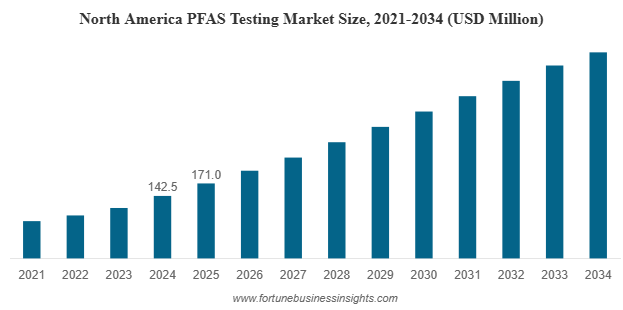
Geographically, North America held the dominant share of the PFAS testing market in 2024 and 2025, with a valuation of USD 142.5 million in 2024 and USD 171.0 million in 2025. The region’s leadership stems from active regulatory oversight—particularly by the U.S. Environmental Protection Agency (EPA)—state-level limits, extensive remediation testing demand, and the establishment of PFAS treatment systems and laboratories.
Europe and Asia Pacific are also expected to register considerable growth during the forecast period. Europe’s expansion is attributed to wide PFAS restrictions, tightened drinking water limits, robust environmental monitoring programs, and growing investment in laboratory infrastructure. Countries such as the United Kingdom, Germany, and France are notable contributors.
Ashwin Arora
Fortune Business Insights™ Pvt. Ltd.
+1 833-909-2966
sales@fortunebusinessinsights.com
Legal Disclaimer:
EIN Presswire provides this news content "as is" without warranty of any kind. We do not accept any responsibility or liability for the accuracy, content, images, videos, licenses, completeness, legality, or reliability of the information contained in this article. If you have any complaints or copyright issues related to this article, kindly contact the author above.
